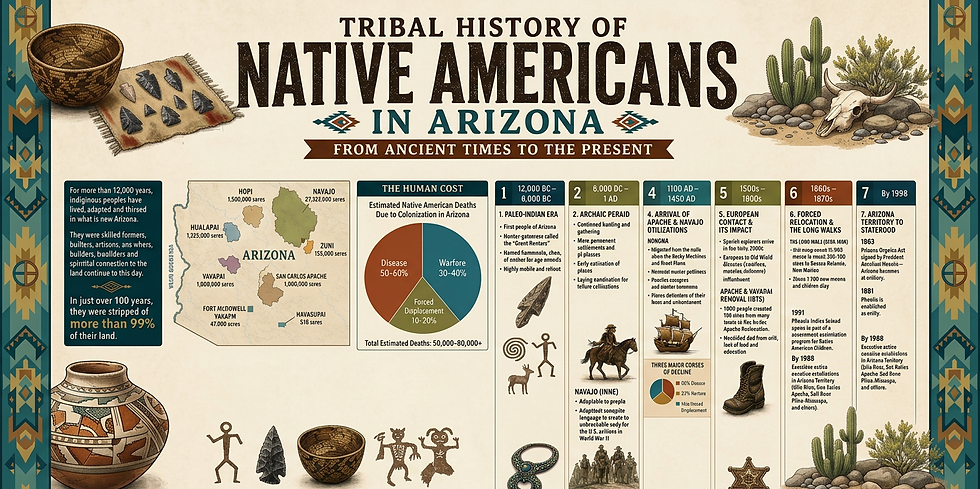
Tribal History of the Southwest
The deserts, canyons and plateaus of what is now Arizona, New Mexico, Colorado and Utah have been home to Indigenous peoples for over 12,000 years. From the earliest Paleo-Indian hunters to the complex agricultural societies of the Hohokam and Ancestral Puebloans, and later the Apache, Navajo, Havasupai and many others, this land has always been rich with culture, innovation and resilience.
This page offers a respectful overview of that history—from ancient engineering feats and sacred homelands to forced marches and survival—and shows how these stories inspire the fictional world of "The Portal."
Early Native American Civilizations
The southwestern region of North America, particularly what is now Arizona, New Mexico, Colorado and Utah, had a rich history of indigenous peoples dating back 12,000 years.
Some of the dominant groups over the millennia included the Paleo-Indians, Anasazi, Apache, Hohokum, Hopi, Hualapai, Havasupai, Maricopa, Mojave, Navajo, Pima, Quechen, Yuma and Zuni tribes.
There are currently 22 federally recognized tribes in Arizona, 17 of which have designated reservations. When considering a larger scope, there are over 575 recognized tribes throughout the Continental United States including Alaska.
Arizona’s first settlers were hunter-gatherers known as Paleo-Indians, or the Great Hunters, who arrived 10,000 to 13,000 years ago; and reigned from roughly 12,000 BC to 6,000 BC. They were a robust group that hunted giant mammoths and bison. This group was followed by the archaic hunter-gatherers from about 6,000 BC to 1 AD.
HERITAGE LIVES • ANCIENT WAYS • STOIC SOULS • RESERVATION LIFE • MODERN LEGACY •
Below are key tribal legacies that shaped the Southwest

Hohokam & the Birth of Phoenix
About 2,000 years ago the Ancestral Puebloans (Anasazi) and Hohokam emerged as highly organized agricultural societies known for their engineering and architectural skills.
The Hohokam lived in the Salt and Gila River valleys from roughly 1 AD to 1450 AD and engineered over 500 miles of gravity-fed canals that brought water to tens of thousands of acres of farmland.
These canals paved the way for modern-day Phoenix.The city’s name was chosen because it rose from the canal infrastructure of the ancient Hohokam civilization. The Hopi, O’odham and Zuni tribes are descendants of the Hohokam.

Ancestral Puebloans & the Great Drought
The Anasazi flourished in the Four-Corners area from about 100 to 1250 AD, building elaborate multi-story cliff dwellings in places such as Chaco Canyon.
Archaeological evidence indicates a mass migration between 1275 and 1300 AD, likely driven by the Great Drought from 1276 to 1299 AD. In a relatively short time, communities moved south in search of new water sources.


Apache & Navajo Journeys
The Apache and Navajo share common roots in the Southern Athabaskan group, part of the larger Na-Dene language family. For thousands of years their ancestors lived in what is now Alaska and northwestern Canada.
Between the 11th and 15th centuries they migrated south more than 1,500 miles along the Rocky Mountains and Great Plains before settling in the American Southwest, adapting to the arid climate and becoming many of the tribes known today.
The Apache were nomadic hunter gatherers known for their fearless warrior spirit, masterful survival skills in extreme environments, and superb horsemanship. Highly skilled in guerilla warfare, they fiercely defended their homeland against Spanish, Mexican and American expansion. Apache warriors had unmatched stamina and were known to cover up to 80 miles on foot in a single day over some of the most unforgiving environments in North America. Some of the most famous Apache war chiefs include Cochise and Geronimo. (See images)
The Navajo were a resilient adaptable people known for their exceptional craftsmanship in weaving and silverwork. But they are most famously known for their critical service to the U.S. military during World War II as developers of an unbreakable military code based on their complex, unwritten native language. Navajo marines would transmit vital tactical messages in the Pacific theater that the Japanese could never break. (See image of Navajo jewelry)

Havasupai: Guardians of the Grand Canyon
The Havasupai, “The People of the Blue-Green Water,” have lived in Havasu Canyon and on the surrounding Grand Canyon plateau for centuries. Once part of the Hualapai within the Yuman culture, they were later split into two tribes by the U.S. government.
In 1882 they were confined to 518 acres at the bottom of the canyon. In 1975, the Grand Canyon Enlargement Act returned more than 180,000 acres, forming their present reservation.
Today they live in Supai Village, 3,000 feet deep within the Grand Canyon, one of the most isolated communities in the U.S. They are regarded as guardians of this sacred landscape.

Contact, Disease & Population Collapse

For millennia, Indigenous peoples of the Southwest lived harmoniously in close relationship with the land, enduring harsh winters, scorching summers, mega-droughts and famines.They were the ultimate survivalists; tough, intelligent and resilient. They were skilled craftsmen, farmers, hunters, engineers, architects and powerful warriors. Their greatest challenge came with European and Mexican expansion.
After contact, Native populations across the Americas fell from about 60 million to 6 million. Three forces drove this collapse: exposure to Old World diseases like smallpox, measles and influenza; violent conquest and genocidal warfare; and forced displacement from ancestral lands to distant reservations.
Tens of millions died from smallpox, measles and influenza since the Native tribes had no natural immunity to these foreign pathogens. Millions more died from brutal genocidal warfare. And thousands died from forced marches under harsh conditions as the Native Americans were displaced off their ancestral lands to designated Federal camps and reservations.
Where Native peoples once occupied nearly all of North America, they now hold about 2.3% of the land through federally designated reservations.
Arizona Territory, Forced Marches & The Long Walk
On February 24, 1863, President Abraham Lincoln signed the Arizona Organic Act, creating the Arizona Territory. Arizona became the 48th state on February 14, 1912, and Phoenix was established as a city in 1881.
By 1898, executive orders had created several major reservations in the territory, including the Gila River Indian Community, the San Carlos Apache Indian Reservation, the Navajo Nation and the Salt River Pima-Maricopa Indian Community.
Under U.S. orders, several forced marches relocated tribal families from their homelands to internment camps and reservations. Between 1864 and 1866, about 10,000 Navajo were forced to march 300–450 miles from Arizona to the Bosque Redondo Reservation in New Mexico in what became known as the Long Walk; roughly 3,500 died.
In 1875, General George Crook forced 1,400 Apache and Yavapai to march 180 miles from Camp Verde to the San Carlos Apache Reservation, with hundreds dying from cold, hunger and exhaustion.
In 1891, the Phoenix Indian School opened as part of an assimilation program for Native children from many tribes, including Apache and Navajo.
